Cupertino’s Pickleball Pilot: More Than Just Noise
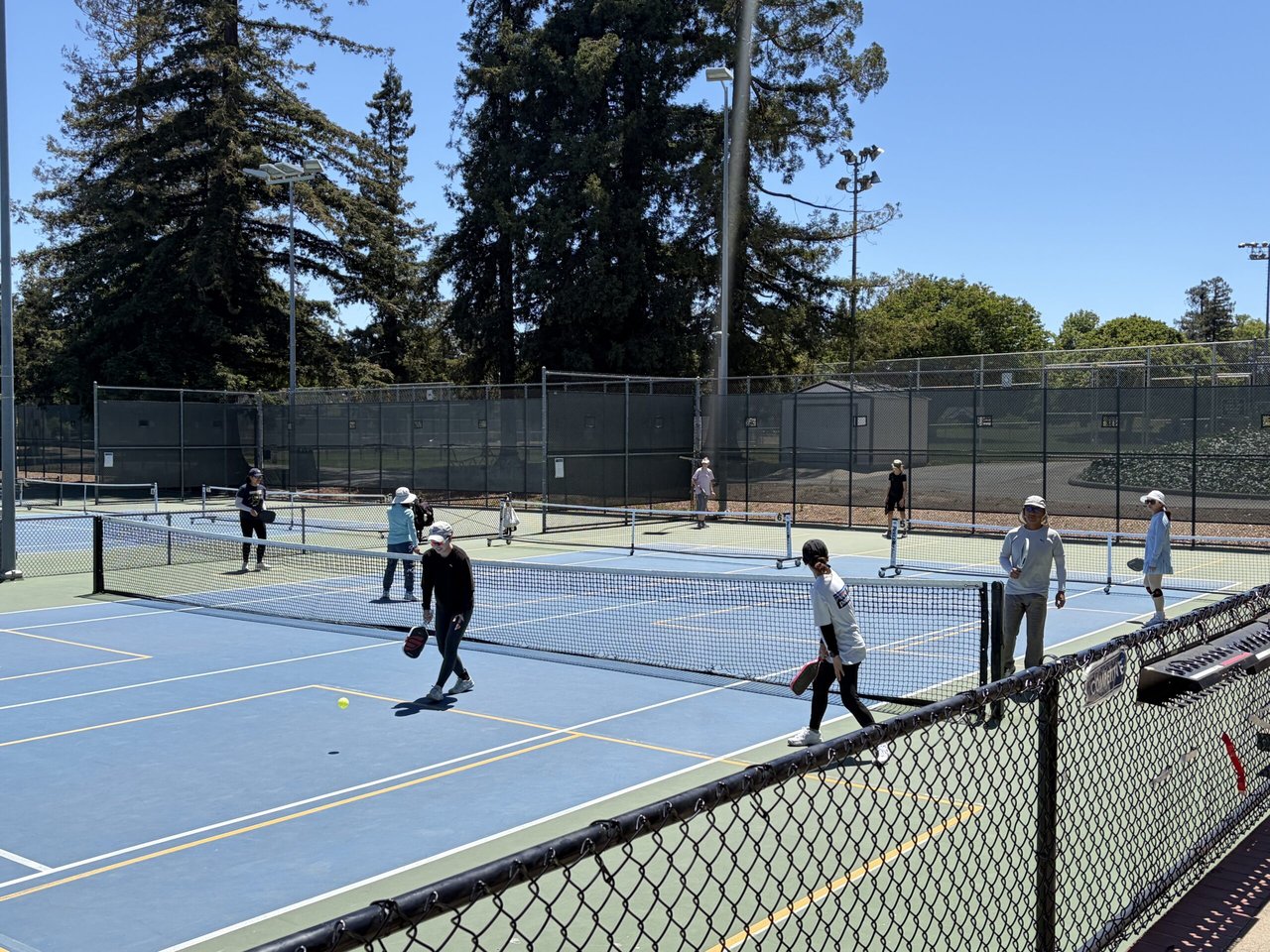
For years, showing up at Memorial Park's eight courts meant one unwritten rule: bring a paddle, set it in the queue rack, wait your turn. No app, no reservation, no fee. Just a fence, a sign-up system built by volunteers, and whoever got there first. That system is still standing. But a new sign on the gate now tells a chunk of Cupertino's regulars they can't use it before 9 a.m. or after 7 p.m., and not at all on Mondays.
The city calls it a noise pilot. Look closer at who it actually restricts and it reads more like a referendum on which Cupertino residents get to treat a free public court as part of their daily schedule, and which ones get squeezed out by it.
The rules took effect July 7, 2026, and run through February 2027, according to a Cupertino Parks and Recreation memo reported by San José Spotlight. The pilot narrows free drop-in play at Memorial Park to a fixed window and removes one day entirely.
Before the pilot | Pilot (July 2026–Feb 2027) | |
|---|---|---|
Days available | Seven days a week | Tuesday through Sunday |
Daily hours | Roughly dawn to lights out | 9 a.m. to 7 p.m. |
Monday play | Allowed | Prohibited |
Equipment | Standard paddles and balls | City asks for quieter paddles and balls |
That last row matters. The city isn't just cutting hours, it's asking the people who still qualify to play differently, with softer equipment, inside a shorter box of time.
Memorial Park's courts didn't become popular by accident. Cathy Chiu, one of the leaders of the Cupertino Pickleball Club, told San José Spotlight that volunteers fundraised for nets, retaped court lines, and built the open drop-in structure that made the courts function without a reservation system.
"We convinced the city that the courts should remain free, but also free of reservation. So it's basically open, drop in play, which means whenever you're available, you bring your paddle, you show up to the court, you put your paddle down on the queue and then you get to play when your turn is up."
That design was deliberate. It meant a retiree with an open Tuesday and a software engineer squeezing in a game before a 9 a.m. standup were playing under the exact same rule: first paddle down, first turn up. The pilot doesn't touch that queue system directly. It just shrinks the hours the queue is allowed to exist.
This is where the noise framing starts to break down. A pilot aimed at reducing decibels near homes would logically target the loudest, most disruptive hours. Instead it targets the edges of the day, which happen to be the only windows some residents have.
Cupertino resident Zoey Tran told San José Spotlight the pickleball community at Memorial Park helped her family feel rooted after moving several times. She said the new restrictions could limit access specifically for working professionals, families, and older adults who rely on early morning or evening play to beat the heat or fit around work schedules.
"This has been truly a lifeline for my family. We feel more rooted and grounded belonging to a community after moving around so much."
Compare that against the complaint that triggered the policy in the first place. A nearby homeowner, speaking anonymously to San José Spotlight, described the previous status quo as running "seven days a week, from 6 in the morning until 9 at night," adding that pickleball's sound is distinct from tennis and harder to live next to.
Both things are true at once. The old hours were long enough to bother a homeowner trying to sleep past 6 a.m. The new hours are short enough to shut out a parent who can only play before the school run or after the commute home. The pilot didn't solve that tension. It picked a side, and the side it picked favors whoever's free time already lands inside a 9-to-7 window.
The version of this story that would actually resolve the standoff is a sound wall near the courts. City officials have said they're evaluating that option, but funding for it hasn't been approved as part of Cupertino's fiscal year 2026-27 budget, which began July 1, and staff are still running additional noise analysis before any permanent measure moves forward, per the same Parks and Recreation reporting.
That detail changes what the current hours actually are. They're not the city's answer. They're a placeholder while the city decides whether it can afford the answer. Mayor Kitty Moore acknowledged as much, telling San José Spotlight the courts are efficient for space but that the noise is a genuine problem, one Cupertino shares with a lot of other cities wrestling with the same sport's growth.
Some residents and players have also raised a simpler question: how does the city plan to enforce quiet-paddle use or the new hours at a court with no gate attendant and no reservation system to check against. Nobody interviewed for the reporting had a clean answer.
So the pilot ends in February 2027 with three open questions still on the table: whether the noise data supports keeping the restricted hours, whether the city can fund a sound wall instead, and whether the volunteer-run drop-in system survives either outcome.
Not every shared-space trade-off in Cupertino is this unsettled. A few blocks away, the neighborhood is running its usual September calendar without a single noise complaint making headlines.
Neither requires a queue rack or a fenced curfew. Both work because the format already matches the demand: a fixed evening slot for the concert series, a fixed Sunday morning for the market. Nobody's litigating who gets the good hours because the hours were never scarce to begin with.
Memorial Park's courts are scarce. Eight courts, one queue, and now a shorter window to use them in. That's the actual mechanism behind this story: when a free resource is genuinely limited, whoever controls the clock controls who gets in.
If you play at Memorial Park, or live close enough to hear it, the number to keep in your head isn't 9 or 7. It's February 2027, when the pilot data gets reviewed and the city decides whether the current hours become permanent, whether a sound wall gets funded, or whether the whole system reverts. Questions on enforcement or scheduling go to [email protected], and city council budget sessions are the place to watch if you want to know whether the sound wall moves from idea to line item.
Cupertino keeps deciding, court by court and Friday night by Friday night, what shared space is supposed to feel like here. Some of those decisions are already settled and working. This one isn't, and it's worth knowing that before you plan next Tuesday's game around it.
If you're thinking about what a neighborhood like this means for your own next move, whether that's a first home search or figuring out what your current place is worth in today's market, Milestone Realty is happy to talk it through. Reach out for a free home valuation or to schedule a consultation whenever the timing makes sense for you.
Stay up to date on the latest real estate trends.

September 24, 2026
September 22, 2026
September 22, 2026
A More Selective Market
September 17, 2026

September 15, 2026
September 10, 2026
September 3, 2026
August 27, 2026
August 26, 2026
Prices Ease, Inventory Tightens, and the Bay Area Stays Competitive
You’ve got questions and we can’t wait to answer them.